What Are Peptides:
Skincare Benefits & Uses
What Are Peptides and
How Can They Support Your Skin?
As skin changes over time, supporting its firmness, smoothness, and resilience becomes increasingly important. Peptides are small chains of Amino Acids often included in serums and creams to help support the skin’s structure.1 In this article, we explore how peptides in skincare work, the main types used, the benefits they may offer, and how to include peptide-based formulas in your daily routine for healthier-looking, firmer, and smoother-looking skin.
What Are Peptides in
Skincare and How Do They Work?

Peptides are short chains of Amino Acids linked together by peptide bonds, which connect Amino Acids within the peptide chain. In the body, peptides can combine with other chains and structures to help form proteins such as collagen and elastin, which are essential for maintaining the skin’s firmness, elasticity, and overall structure.2
In skincare, peptide-based ingredients are used in serums, creams, and targeted treatments designed to support the skin’s natural processes. Depending on their structure, different peptides can help support functions such as collagen production, helping skin appear firmer and smoother-looking over time.3
What Is a Peptide?
What Are Peptides: Peptides are short chains of Amino Acids that act as building blocks for proteins such as collagen and elastin, which help support skin firmness and elasticity.
How Do Peptides Work: The way peptides work can vary depending on their type. For example, signal peptides may help send signals to skin cells, encouraging the production of structural proteins such as collagen and elastin.
Benefits for Skin: Peptides used in skincare can support a range of skin benefits depending on their type, such as helping to improve the appearance of skin elasticity, reduce the look of wrinkles, and support the skin barrier.
Where Are Peptides Used in Skincare: Commonly found in serums, moisturisers, and targeted treatments designed for specific skin concerns, such as wrinkles or loss of firmness.
CAN SUPPORT THE SKIN

- 1Support Collagen Production:
Collagen is one of the most abundant proteins in the body and plays a key role in maintaining skin firmness and structure. Certain peptides can encourage skin cells to produce more collagen, helping skin appear smoother and firmer over time.
- 2Help Improve Skin Elasticity:
Elastin is another structural protein that allows skin to stretch and return to its original shape. Some peptides can support elastin production, helping skin appear more flexible and resilient.
- 3Soften the Appearance of Wrinkles:
As collagen and elastin decline with age, wrinkles and fine lines may become more visible. Some peptides can help skin appear plumper and smoother-looking, which can soften the appearance of these lines.
- 4Strengthen the Skin Barrier:
The skin barrier protects against environmental stressors such as pollution, toxins, and UV exposure. Certain peptides can help support this barrier, allowing skin to retain moisture more effectively.
- 5Support Skin Repair:Some peptides, particularly Copper peptides, are known for their antioxidant and anti-inflammatory properties. They can help support the skin’s natural recovery processes and improve the appearance of skin texture.⁴
Peptides in Skincare
There are many different peptides used in skincare formulas, each with slightly different functions. Many products combine several types to help support multiple skin processes at once. By understanding their roles, you can see how peptides can help improve firmness, hydration, and overall skin resilience.5
- 1Signal Peptides
Signal peptides send messages to skin cells that can help support natural processes such as collagen and elastin production. This can help skin appear firmer and smoother over time. Collagen-boosting peptides in particular may support the skin’s natural collagen production, helping it to look more plump and firm.
- 2Carrier Peptides
Carrier peptides transport trace minerals, such as Copper, to skin cells. These minerals can support skin repair processes and antioxidant protection. For example, Copper peptides are known for their antioxidant and anti-inflammatory properties. They can help support skin regeneration, improve the appearance of skin firmness, and reduce the look of redness.
- 3Neurotransmitter-Inhibiting PeptidesThese peptides may help reduce the release of neurotransmitters, which are compounds that signal muscles to contract. By helping to relax facial muscles, they can help soften the appearance of expression lines over time.
- 4Enzyme-Inhibiting PeptidesThese peptides may help slow down the activity of certain enzymes in the skin, including those involved in the breakdown of collagen and elastin. This can help support the skin’s firmness and elasticity over time.
- 5Multifunctional PeptidesMultifunctional peptides can offer a range of benefits for the skin. In particular, they can help support hydration, regeneration, and improve the skin’s suppleness over time.
How to Use Peptides
in Your Skincare Routine
Start your routine with a gentle cleanse. Cleansing helps remove dirt, sebum, and environmental pollutants from the skin, preparing it for the next steps in your routine and helping active ingredients to be absorbed more effectively.
Serums deliver concentrated active ingredients directly into the outer layer of the skin and are often used to target concerns such as reduced firmness, dehydration, and visible signs of ageing.7 Peptide-containing serums can help support the skin’s natural production of structural proteins such as collagen, which can contribute to smoother and firmer-looking skin over time.
Tip: For optimal results, apply peptide serums once or twice daily, ideally after cleansing and before moisturiser. They generally work well alongside ingredients such as Hyaluronic Acid or Ceramides. However, it may be best to avoid layering them directly before or after products containing strong exfoliating acids, such as Glycolic Acid, as this can affect how well the peptides perform.8
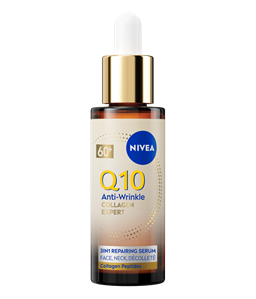
- NIVEA Q10 Anti-Wrinkle Collagen Expert 3in1 Repairing Serum contains Q10, collagen Peptides, and Ceramide to help improve skin elasticity and support firmer-looking facial contours. With regular use, it can help reduce the appearance of deep wrinkles while leaving skin feeling hydrated.
Q10 3in1 Repairing Serum >
Alternatively, if you are looking for a more targeted effect on specific areas such as the forehead, eye area, or nasolabial folds, you may prefer:
- NIVEA Q10 Anti-Wrinkle Power Expert Targeted Wrinkle Filler Serum is formulated with a 5% Active Complex of Pure Coenzyme Q10 and Bioxifill Peptides. This targeted serum can penetrate multiple layers of the skin to help stimulate collagen production and visibly reduce the appearance of fine lines and deeper wrinkles in specific areas, such as the forehead, eye area, and nasolabial folds.


Step 3: Moisturise
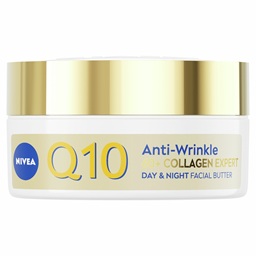
Moisturising helps lock in hydration and support the skin barrier, allowing peptide-based formulas and other active ingredients to work effectively.9 The NIVEA Q10 Anti-Wrinkle Collagen Expert Day & Night Facial Butter contains collagen Peptides, Ceramide, and Pure Q10. Its rich texture melts into the skin to help nourish the skin barrier, support elasticity, and can help reduce the appearance of wrinkles over time.
Q10 Anti-Wrinkle Facial Butter >
Step 4: Protect with SPF (Morning Routine)
Daily sun protection helps maintain healthy-looking skin and shield it from UV-induced ageing. Using sunscreen with peptide-based skincare can help support the skin while protecting it against environmental stressors that can affect firmness.10
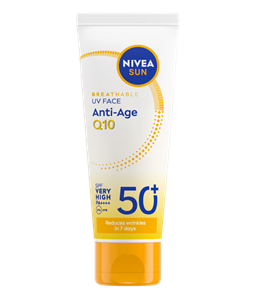
The NIVEA SUN Breathable UV Face Anti-Age Q10 SPF50+ delivers broad-spectrum protection with breathable UV technology. Enriched with collagen Peptides, Q10, and Licochalcone A, it helps support firmer-looking skin and reduce the appearance of wrinkles.
Summary
Peptides are short chains of Amino Acids that help form essential proteins such as collagen and elastin, which support skin firmness and elasticity. In skincare, peptides can help encourage the production of these proteins, allowing skin to appear smoother and more resilient over time. By incorporating peptide-based skincare products such as serums and moisturisers into a consistent routine, skin can feel more hydrated, supported, and firmer-looking.
FAQs
The effects of peptides in skincare can vary depending on their structure. For example, certain peptides can help support the skin's natural production of collagen and elastin, proteins that play an important role in maintaining the skin's structure. By supporting the formation of these proteins, these peptides can help reduce the appearance of wrinkles and improve the skin's elasticity over time.
Peptides may support skin firmness, hydration, and resilience. Because peptides interact with skin cells, they may encourage the production of supportive proteins and strengthen the skin barrier.
Peptides are generally suitable for all skin types, including sensitive, dry, and combination skin. However, it may be helpful to patch-test new products.
Peptides generally work well with many skincare ingredients, including Hyaluronic Acid, Niacinamide, and Ceramides. Some acid exfoliants may affect how well peptides perform. It may therefore be best to apply peptide products separately when using multiple active skincare ingredients.
Peptides and Niacinamide have different effects on the skin. The benefits of peptides can vary depending on their type; for example, they can help support collagen production and improve the appearance of skin firmness, while Niacinamide helps improve skin tone and support the skin barrier. Many skincare routines include both ingredients as they complement each other well.
Peptides and Retinol play different roles in skincare. Retinol supports skin renewal and helps reduce the visible signs of ageing, while peptides can offer a range of benefits depending on their formulation, including supporting the skin's structure and elasticity. Some skincare routines include both ingredients as they provide complementary benefits. However, Retinol may increase the likelihood of skin sensitivity, including sensitivity to sunlight. For those with sensitive skin, Bakuchiol can be considered as a gentler, plant-derived alternative to Retinol.
Common peptides used in skincare include signalling peptides, such as collagen peptides, and carrier peptides, such as Copper peptides. Their effectiveness can vary depending on their structure and the overall formulation. The best peptide for you will depend on your skin's needs; some can help improve the appearance of firmness, while others can support hydration or overall skin vitality. Choose skincare products that have been dermatologically tested for skin tolerance.
Sources :
1. Andrada Pintea; Manea, A.; Cezara Pintea; Vlad, R.-A.; Bîrsan, M.; Antonoaea, P.; Emöke Margit Rédai; Ciurba, A. Peptides: Emerging Candidates for the Prevention and Treatment of Skin Senescence: A Review. Biomolecules 2025, 15 (1), 88-88.
https://doi.org/10.3390/biom15010088
2. Forbes, J.; Krishnamurthy, K. Biochemistry, Peptide. PubMed.
https://pubmed.ncbi.nlm.nih.gov/32965931/
3. Al-Atif, H. Collagen Supplements for Aging and Wrinkles: A Paradigm Shift in the Field of Dermatology and Cosmetics. Dermatology Practical & Conceptual 2022, 12 (1), e2022018.
https://doi.org/10.5826/dpc.1201a18
4. Tang, Y.; Nie, T.; Zhang, L.; Liu, X.; Deng, H. Peptides in Cosmetics: From Pharmaceutical Breakthroughs to Skincare Innovations. Cosmetics 2025, 12 (3), 107-107.
https://doi.org/10.3390/cosmetics12030107
5. Waszkielewicz, A. M.; Mirosław, K. Peptides and Their Mechanisms of Action in the Skin. Applied Sciences 2024, 14 (24), 11495.
https://doi.org/10.3390/app142411495
6. Mukhopadhyay, P. Cleansers and Their Role in Various Dermatological Disorders. Indian Journal of Dermatology 2011, 56 (1), 2.
https://doi.org/10.4103/0019-5154.77542
7. Bilodeau, K. Skin serum: What it can and can't do. Harvard Health.
https://www.health.harvard.edu/blog/skin-serum-what-it-can-and-cant-do-2018061214029
8. Nugrahadi, P. P.; Hinrichs, J.; Frijlink, H. W.; Schöneich, C.; Avanti, C. Designing Formulation Strategies for Enhanced Stability of Therapeutic Peptides in Aqueous Solutions: A Review. Pharmaceutics 2023, 15 (3), 935-935.
https://doi.org/10.3390/pharmaceutics15030935
9. Rajkumar, J.; Chandan, N.; Lio, P.; Shi, V. The Skin Barrier and Moisturization: Function, Disruption, and Mechanisms of Repair. Skin Pharmacology and Physiology 2023, 36 (4).
https://doi.org/10.1159/000534136
10. Krutmann, J.; Schalka, S.; Watson, R. E. B.; Wei, L.; Morita, A. Daily Photoprotection to Prevent Photoaging. Photodermatology, Photoimmunology & Photomedicine 2021, 37 (6), 482-489.
https://doi.org/10.1111/phpp.12688
11. PeptideJournal. How to Layer Peptide Products with Other Actives. PeptideJournal.
https://www.peptidejournal.org/how-to/how-to-layer-peptide-products-with-other-actives (accessed 2026-05-20).
12. Cook, B.; Riggs, M.; Holley, K. C.; Knaggs, H.; Ganesh Diwakar; Lephart, E. D. Effects of Retinol, Natural Pea Peptide and Antioxidant Blend in a Topical Formulation: In Vitro and Clinical Evidence. Dermatology and Therapy 2024.